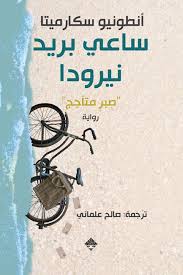
Unlike the rest of the men in his village, Mario decides not to spend his life as an ordinary fisherman, so he decides, using his bicycle, to work as a postman in a small village, even though it only has one person who receives and sends letters. Chile's greatest poet, Pablo Neruda.
In his exile there, the poet lives as an observer and participant in the great changes taking place in Chile, and through small meetings and discussions about love, poetry and politics, a special relationship is established between him and the young postman who is immersed in love and enchanted by Neruda’s poetry, which he sees as his right because poetry does not belong to its writer but to those who need it. .
Through charming details of the human relations in a small village between the poet steeped in politics and the postman in love steeped in poetry, Scarmeta recounts the great political changes that took place in Chile and the rise and fall of revolutionary dreams.
Khaled is a young man in his thirties who graduated from the College of Fine Arts. He failed to travel from his city of “fairies,” which was closing in on him from all sides, so he had no choice but to work as an employee in a bookstore, through which he practiced an additional, secret job in which he sold his works of fiction. Life would have gone better if one could keep the secret, but as Faraj, Khaled’s father, says: “No matter how much you hide it, the secret will wake up inside you one day, and then it will continue to burrow into your soul until it is released to the world.” Thus, Khaled’s choices in life soon put him in the face of “Khalil Nayef,” a lawyer with wide influence who wants to enter the world of writing.
Within a suspenseful context and a rapid pace, Tamim Heneidi dives into the scenes of the relationships between writers, publishers, and bookstore owners, and sheds light on the way in which culture may be used to polish the image of the political class created by the war. But can books perform a task like this?







/The Power of Love Connecting to the Oneness-1718342915.jpg)